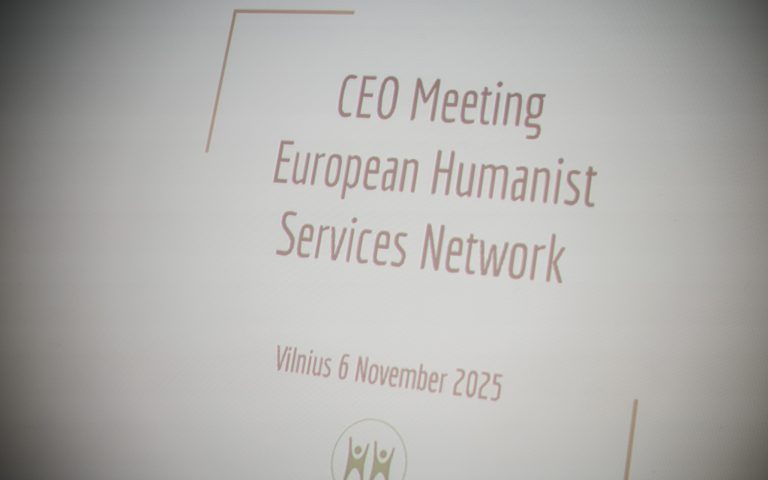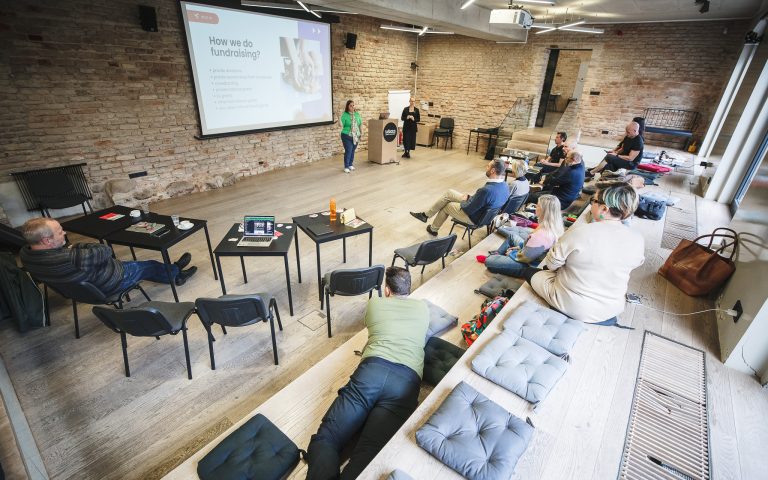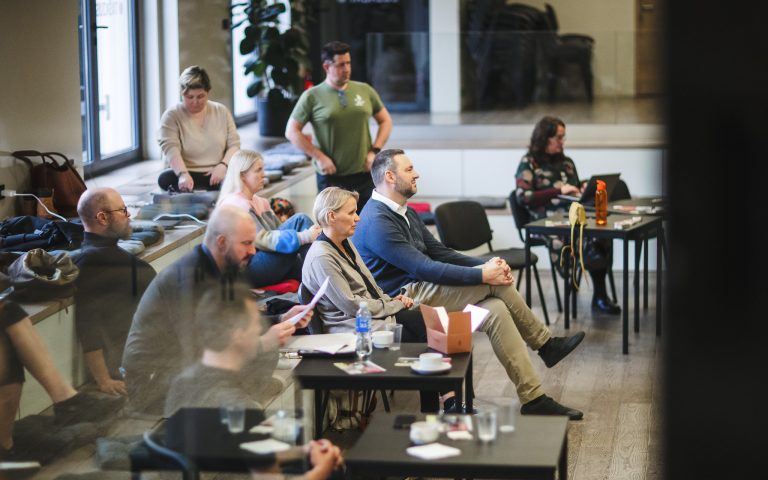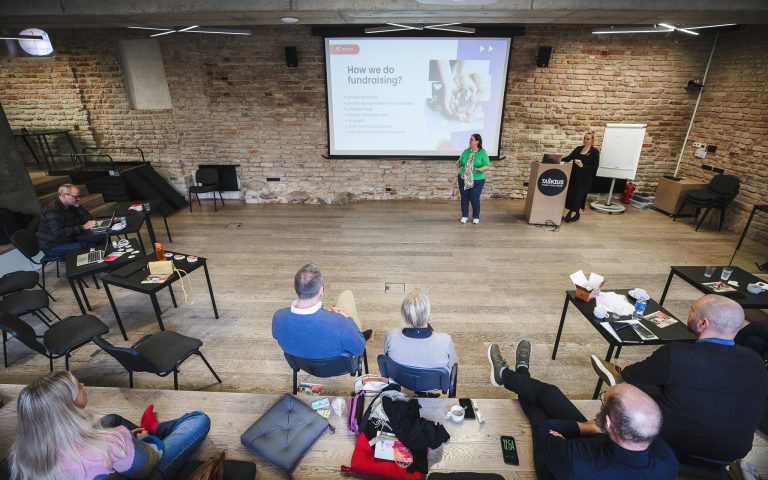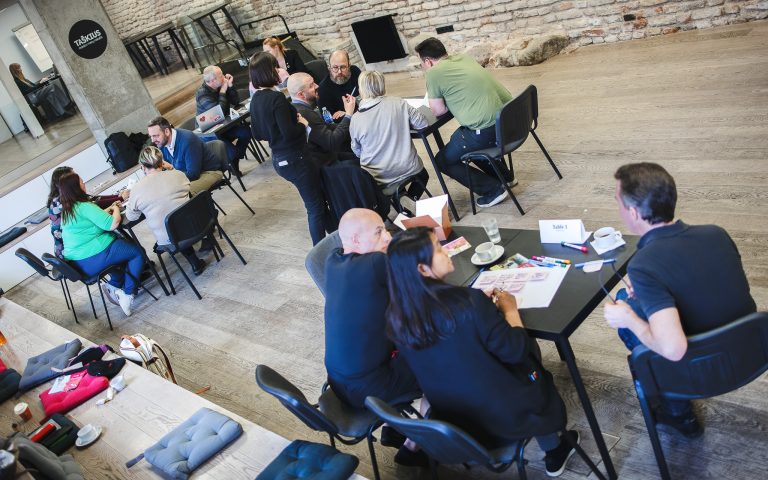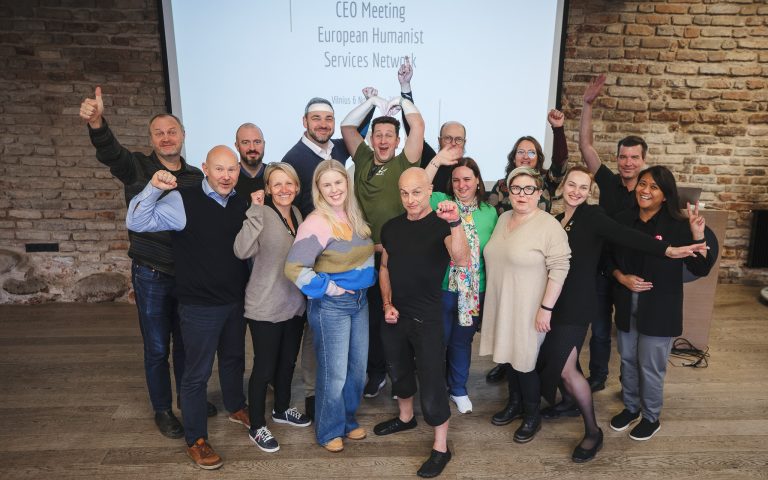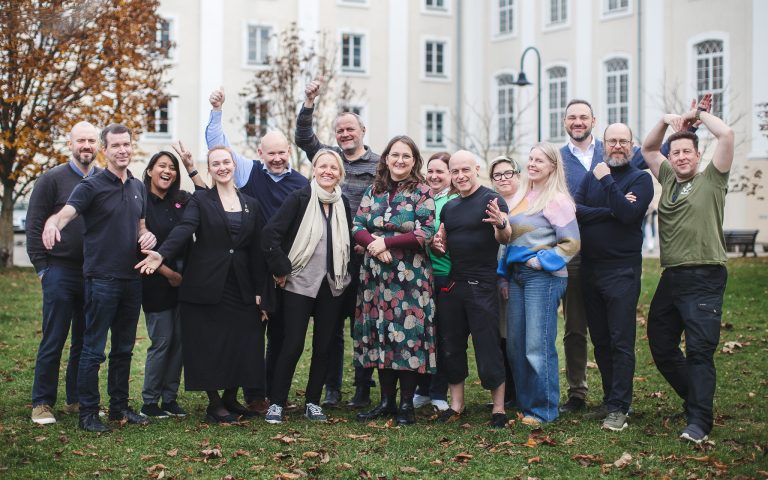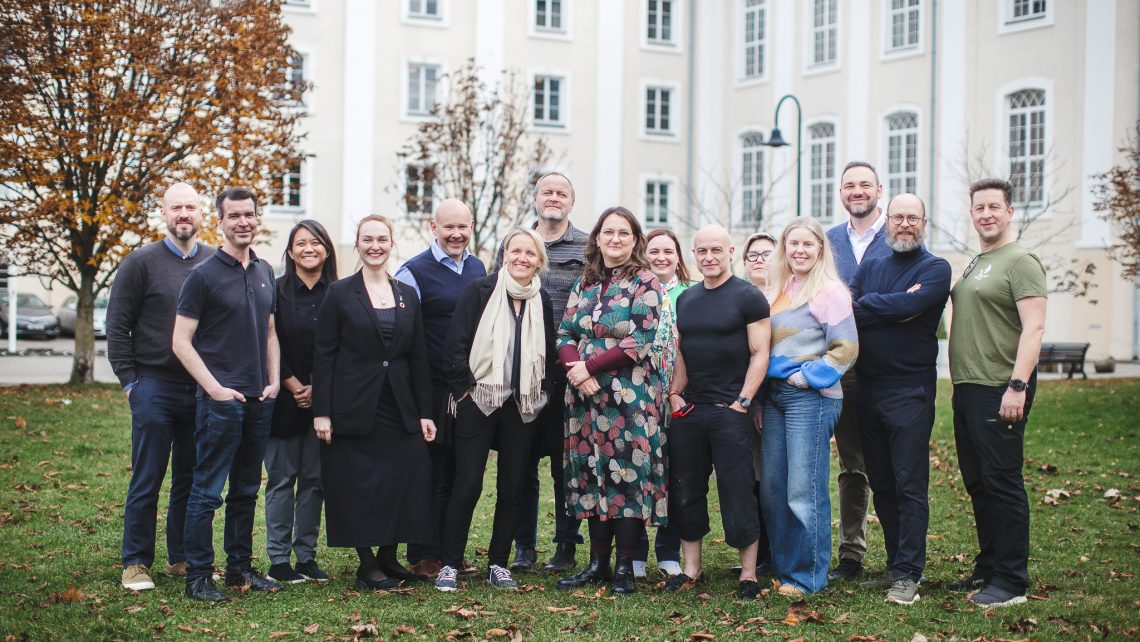
On 5 and 6 November 2025, the executive directors and senior representatives of 19 humanist organizations from Europe met in Vilnius for the annual meeting of the European Humanist Services Network. The meeting was hosted by the Lithuanian organization Humanistai – HIA Lithuania. Katrin Raczynski, who is responsible for our international work, attended on behalf of the Humanist Association of Germany.
The meeting was all about joint professionalization: humanistic services – such as humanistic weddings, youth celebrations or existential counselling – are to be made more visible throughout Europe, safeguarded in terms of quality and strengthened in their social value.
Fundraising: Experiences from Romania – Inspiration for Europe
Monica Belitoiu from ASUR (Romania) offered a particularly lively insight. In her practical report, she showed how a comparatively small, fully project-financed association manages to continuously raise donations – from small private donations to corporate partnerships and EU funding programs.
Their message: fundraising is not an extra, but a basic requirement for stable humanist work. ASUR shows how creative campaigns, continuous presence (“fundraising happens every day”) and the professional use of funding make growth possible – even without state support.
Many participants were grateful for these impulses. For the European Humanist Services Network is planning to launch a coordinated European fundraising initiative in 2026, which will strengthen both common messages and the exchange among those responsible for communication and fundraising.
How secular is Europe – and what does this mean for humanist work?
The lecture by sociologist of religion Atko Remmel (University of Tartu, Estonia) offered a scientifically sound view of the religious and ideological situation in Europe. His research shows:
- In many regions of Europe, the group of people who have grown up without religious socialization is growing.
- “Religious indifference” is widespread today – but it does not mean indifference to questions of meaning and life.
- At the same time, many people lack a language for existential topics. Traditional religious terms are disappearing, but new humanistic vocabularies are still too little established.
This is precisely where Remmel sees a key opportunity for humanists:
Humanist organizations have expertise in life celebrations, educational work and existential support – in other words, precisely where people are looking for guidance but do not want to resort to religious formats.
Remmel’s research is directly relevant to the European Humanist Services Network, for example in the development of common standards, such as for humanist weddings, and the establishment of professional structures in the field of humanist existential care, which is to receive a European standard work and an accreditation model in 2026.
Setting the organizational course
In addition to substantive contributions, key documents were adopted: the 2025 annual report, the 2026 work programme and the strategic guidelines until 2027. The network is particularly strong in the area of humanist weddings, where 20 organizations are now working together. The launch of the joint European website humanistweddings.eu was a milestone in 2025.
There are now also structured, international working groups and concrete projects in youth work and humanistic existential care – including a European youth camp in 2027 and a workshop on humanistic existential care, which was successfully launched in Berlin in October of this year.
Conclusion: A network grows together
The meeting in Vilnius showed once again that humanists in Europe face similar challenges – and can achieve a great deal together. The mixture of practical insights, scientific analysis and strategic planning made for an extremely productive, collegial meeting.
For us, participation in the European Humanist Services Network is not just European cooperation, but a contribution to a common humanist infrastructure that benefits people throughout Europe