“Without legal regulations, there will be no assisted suicide by the medical profession, because it is extremely uncertain and hesitant despite the now guaranteed impunity,” says Gita Neumann, Federal Representative for Medical Ethics and Autonomy at the End of Life at the HVD. On February 26, 2020, the Federal Constitutional Court declared the ban on assisted suicide under Section 217 of the Criminal Code, which was introduced in 2015, to be unconstitutional and null and void. However, the interpretation of narcotics law and, in particular, whether and how the drug sodium pentobarbital, which is particularly suitable for the purpose of suicide, should be released, was not the subject of the Karlsruhe proceedings.
“We have an urgent need for regulation: doctors continue to block constitutionally guaranteed requests for assisted suicide, as they are helpless in the face of such a request without any instructions for action. Euthanasia organizations have become active again, but in this country they only have second-choice drugs available. And on the other hand, potential profiteers could legally offer non-drug methods and means of suicide,” says Neumann, summarizing the current situation.
“There is a growing group of older people who would like to keep an assisted suicide option open for their future. However, this raises questions about due diligence criteria, such as the required voluntary capacity, and possibly also conflicts that require value-neutral and open-ended specialist advice,” says Neumann. All of these problems and hurdles were included by the Humanist Association of Germany in its comprehensive draft of a “Law for the management of assisted suicide and suicide conflicts”. The draft law was initially made available to those members of the Bundestag who had already presented a position against Section 217 StGB in 2015 that was most likely to be constitutional.
As the Federal Constitutional Court states in the grounds for its judgment, the opinions of the statements by the Humanist Association of Germany were among the few that had clearly spoken out against the ban on assisted suicide under Section 217 StGB.
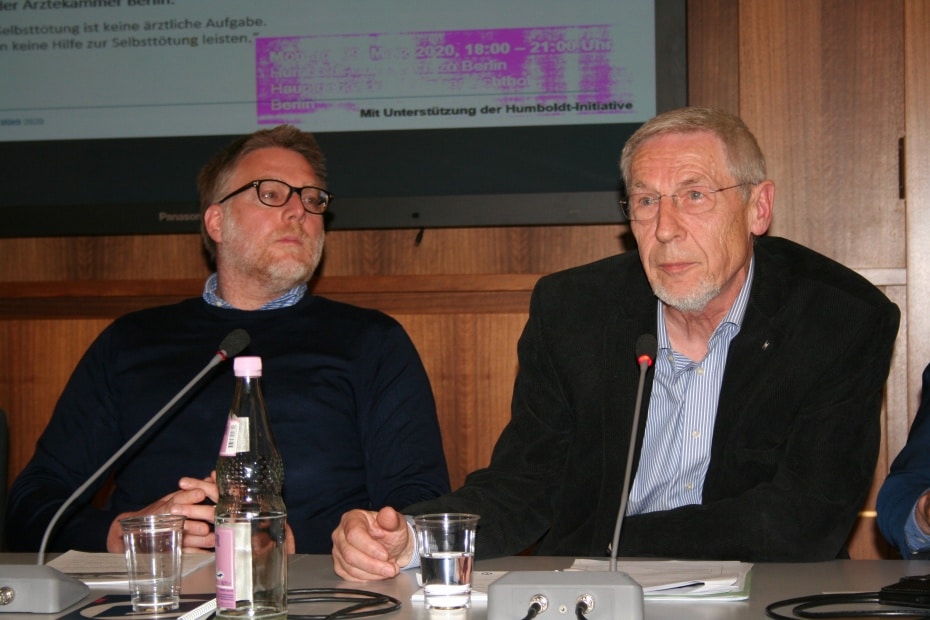 Bild: Frank Spade
The regional associations of the HVD, as providers of numerous institutions in the social, health and senior citizens’ sectors, have a wealth of experience with suicide and dying wishes. “We have always relegated pressure on old and sick people to commit suicide to the realm of ideological, religious or even interest-driven ‘protection of life’,” emphasizes Erwin Kress, Chairman of the Board of the HVD Federal Association. “It is good that we can now tackle the real problems of assisted suicide. We are calling for a reliable framework for action and are submitting an elaborate proposal to this end.”
The draft law can be downloaded here .