In an interview about the first religious policy congress of Bündnis 90/Die Grünen, the President of the Humanist Association of Germany says that a qualified public debate on the overdue development of modern legal relationships between “state and religion” has not even really begun.
Mr. Wolf, after the religious policy congress of Bündnis 90/Die Grünen , a report in the taz newspaper suggested that you had spoken out at the congress against the positive equal treatment of Muslims living in Germany with members of the Christian religious communities. This contradicts the positions you presented before the congress.
Frieder Otto Wolf: I didn’t say that at all. Rather, I vehemently advocated equal treatment of religions and worldviews and also expressly advocated that there should be public recognition on an equal footing for all regional and worldview communities, as well as clear support wherever they contribute to the public good, such as in the education system. And I have also left no doubt that Islam is part of this and have distanced myself from all attempts to exclude Islam from the German public sphere in the name of criticism of religion and to equate Islam, Islamism and terrorism legitimized by Islamism. However, I have also warned that the Christian churches could attempt to defend their current privileges by including Islam in the existing “cartel”, as it were.
Why didn’t the newspaper present this correctly?
I can only make assumptions: On the one hand, due to the constant drumbeat of the churches over the last decade, many journalists have obviously adopted the false equation of secularism and the suppression of religion and worldviews from the public sphere in their heads, so that for them any criticism of the current privileges of the Christian churches in Germany sounds like a fundamental rejection of all religiosity; on the other hand, they obviously have no idea whatsoever of non-religious worldviews that claim to be heard, recognized and promoted on an equal footing in the public sphere. Based on these two assumptions, some journalists can apparently only imagine that a critical examination of church privileges and the validity claims of religions amounts to a skeptical renunciation of them: to develop and justify a more comprehensive attitude towards one’s own existence in the world, as the concept of worldview, which is laid down in the Basic Law and now seems somewhat dusty and therefore urgently in need of theoretical renewal, means.
The report also states that you advocate a stronger separation between churches and the state.
Indeed I do. And that doesn’t just refer to the Reichsdeputationshauptschluss, which in turn established church privileges in Germany as compensation for the absolutist theft of the church, and for which there has been an as yet unfulfilled requirement of redemption since the Weimar Constitution. From the collection of state church taxes to pastoral care in the armed forces, in prisons and also in the area of emergency pastoral care through to the broadcasting councils, the Christian churches today have a variety of privileges in what lawyers have described with an apt metaphor as the “limping separation of church and state”. Just one striking example: In the state of Brandenburg, about two-thirds of whose population has nothing to do with the churches, the Christian churches are funded by the state to the tune of tens of millions, while a contribution in the single-digit thousands is made available for the public activities of the Humanist Association. In contrast, however, we are not calling for religions and world views to be relegated to private life. The reality of the programmatic separation of state and religion in the USA and France is a warning to us: In the USA, this form of separation has led to public enlightenment and scientific reflection remaining largely outside of Christian self-understanding, so that in addition to commercialization and sponsor dependency, open irrationalisms such as those of “creationism” and the so-called “evangelicals” have a free field in the Christian public; in France – less spectacularly – to a concealed self-evidence of Catholicism in the national culture, which clever people have termed “catho-laicity”. As a sensible and realistic transformation of the German state-church system towards a public constitution for religions and worldviews, we therefore advocate the Dutch and Belgian system of laicism, which does not aim to oust religions and worldviews from the public sphere and from state institutions, but instead practices the equal inclusion of everything that is addressed in the German Basic Law under religions and worldviews. This model, which we advocate as the best solution, can be described as cooperative secularism.
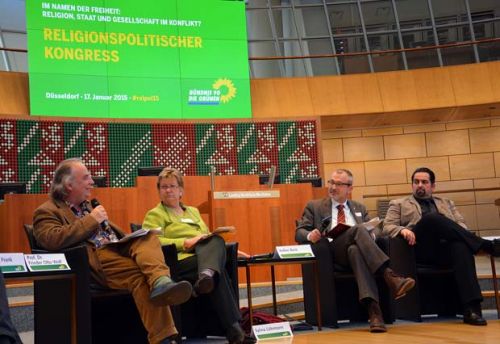
Frieder Otto Wolf, Sylvia Löhrmann, Volker Beck, Aiman A. Mazyek (from left) in the Düsseldorf state parliament. Photo: Ricarda Hinz
Can you briefly explain what is meant by cooperative secularism?
This formulation constructively takes up what was a repeatedly expressed basic idea at the Greens’ regional policy congress: namely the conviction that the relationship of the state to religions and world views must be formulated in a way that ensures as far as possible that these are practised in public responsibility and in the midst of public discourse. However, while this idea has been articulated at this congress in a mostly limited way in terms of religious policy – after all, in the course of the congress it has obviously become accepted to always refer to world views, at least verbally – I consider it necessary to accentuate this basic idea in a secular way: In a society such as Germany’s, in which non-denominational people now form the largest population group in terms of ideology and religion, ahead of Protestants and Catholics, I do not believe it is realistic to continue the existing privileges of the two traditional Christian mainline churches, which are enshrined in law in many ways and still articulated as a matter of course in the minds of many constitutionalists. A reform of the current state-church law into a public law of religions and world views is also urgently needed so that the self-evident equal treatment of Islamic religious communities – the Alevi regional community has taken on a pioneering role here, which we actively support as an association – can be implemented on the necessary broad scale.
The Hamburg-based writer Simon Urban also said last week in a commentary on ZEIT Online that the growing equality of Muslims is a central motive for the Islamophobic “Pegida” movement.
I consider this to be an ideological sham, which, however, has been strongly promoted by the ideology of an Occident under the banner of the crusade against communism, which was then given a new enemy in the form of “Islam” as a basis for its existence at the beginning of this millennium. The conservative so-called “elites” of our country, who still primarily present themselves as “Christian”, have a lot to make up for here. In real terms, on the one hand, it is about fears of decline among certain sections of the middle class, as well as the feeling, which is entirely justified, that politics is taking place and developing in a way that makes any democratic participation by broader sections of the population more and more impossible. This has now given rise to resentment – apparently reinforced by the disappointment of the expectations raised by reunification – for which quite openly racist incitement against Muslims obviously provides a suitable hook.
The author also said that “rigorous secularism” could remove the breeding ground for “Pegida” supporters and the conflicts between the religious camps.
This thesis is based on two false assumptions: Firstly, on the premise that a separatist secularism, which seeks to ban religions and world views from private life, is somehow stricter than the “cooperative secularism” we advocate, which is already practised in the Netherlands and Belgium; and secondly, that Pegida is a “conflict between religious camps” in the first place. The vast majority of Pegida supporters are not religious in any way, as existing studies show – and I would like to add here that I believe I have reason to suspect that they do not have a reflected or minimally developed world view either: Like a large proportion of non-denominational people, Pegida supporters are likely to have rather unprocessed remnants of widespread ideologies in their heads.
And do you also see this “secular majority” that opponents of the model of cooperative secularism repeatedly refer to?
I see a strong need for differentiation here: on the one hand, even among those who still formally belong to Christian churches, there are double-digit percentages of people who are no longer religiously oriented in any recognizable way; on the other hand, I see only a portion of those who are non-denominational as seriously trying to clarify their own world view. There was a comment made at the congress that was certainly a little off the mark, but nevertheless hit an important point: a representative of Buddhism argued that the discussion was suffering from the fact that the most important religion practiced in Germany was not represented as such – namely the everyday religion of “consumerism”. As organized humanists, we should be aware that although our worldview probably articulates the thinking of a majority of non-denominational people and of various minorities among members of churches and religious communities, all kinds of other orientations – and also disorientations – can also be found among both non-denominational and avowedly religious people. In any case, the term “secular” is not suitable for describing any tangible type of comprehensive ideological orientation. Properly understood, it only refers to the one point of separation between state and religion: the fact that we in Germany are still discussing whether church and state should be separated and have not begun to agree on how this should be done in a meaningful way, i.e. whether “separatist” or “cooperative”, shows how far behind we are in the debate on what status religious and ideological orientations can and should have within modern democratic states.
But you can understand that many secular citizens are tired of the public and political tug-of-war over the relationship between the state and religious communities?
The question makes one assumption, which I doubt, namely that there is already such a “public and political tug-of-war” in Germany. I don’t see that so far – the Green Party’s religious policy conference was nothing more than a first attempt to initiate a qualified public debate of this kind, which I believe is urgently needed and therefore welcome. Despite the abbreviation of religious policy in the approach taken by the Greens.
Let’s take a free spin: Would there perhaps be a need for a separate party for secular voters?
As already mentioned, the term “secular” refers to a very specific point – to the public constitution of the relationship between religious or ideological communities and state institutions. “Secularism” is therefore not really conceivable either as a world view or as a political program. In Germany, there are not only “secular Greens”, for example, but also corresponding groups in the SPD and the LINKE party – and not to forget the FDP, which has now slipped below the five percent mark. There is therefore no basis whatsoever for an attempt to build a new approach to party-political organization around the issue of the separation of church and state.
In the Bundestag and in the so-called Sunday polls, the CDU/CSU parliamentary group remains strong. Why is it that a society as strongly secularized as ours votes for a Christian Democratic government?
From the outset, one of the Christian Democrats’ basic ideas has been to politically defuse the traditional confessional divide between Catholics and Protestants. In the meantime, they are also trying to integrate Muslims who are willing to join their liberal-conservative political program. Even if a vague “reference to God” or a privileged reference to an imagined cartel of religious communities may still play a role in the Union’s self-image, this no longer has any particular significance for its political program on the whole.
In the meantime, there are also an increasing number of experts in the churches who are calling for the renewal of state church law towards a religious and ideological constitutional law based on the ideas of cooperative secularism, so that the interests of non-denominational people and people of other faiths are better taken into account. Would you dare to predict when there will be noticeable movement in this area?
On the panel in the Düsseldorf state parliament on the legal issues of religious and ideological communities, the canon law expert Prof. Dr. Traugott Jähnichen was certainly one such expert who largely agreed with our positions and demands. A slow process of change is underway within the legal community – within which, just a few years ago, the opinion that Islamic religious communities were not churches and could therefore have no part in state-church law was still capable of promotion – which, due to the weight of the arguments and the social fact of the loss of importance of the Christian churches in Germany, is certainly moving in our direction. It is difficult to predict when and to what extent such views will also prevail in legislation and administration – especially as religious and ideological constitutional law is not a central topic of social and political debate. However, I see the fact that the Greens have now taken up this issue as an indication that the decades-long political stagnation on this issue is beginning to dissipate. However, we will have to make sure that this movement is not just satisfied with the improved integration of Muslims and Alevis, but also brings the ideological communities on an equal footing in public law.
What do you say to supporters of the anti-religion and anti-church camp in Germany who attribute a lack of courage to you when it comes to calling for radical reforms towards a rigid secularism like that in the USA or France?
I can be relatively simple here: As outlined above, cooperative secularism is neither a light version nor a timid variant of secularism. It is serious about ending the privileges of the Christian churches, but without releasing them from their public responsibility. By demanding and enforcing the equal treatment of all religious and ideological communities in the public sphere – and by recognizing and promoting them in accordance with their real social significance – it makes important cultural, i.e. intellectual and practical, resources productive for public life.
In a frightening radicalization of believers, I mean the attacks on the editorial office of “Charlie Hebdo”, as in Paris, would you also see the failure of the French system to a certain extent?
I don’t want to instrumentalize these murderous, terrorist attacks, which we can only condemn unconditionally, for something else. However, I do think that the influence of Islamist terrorism on certain segments of Muslim youth in France has to do not only with the lack of economic prospects and socio-cultural exclusion experienced by them, but also with the fact that French Catholicism as such can at best provide very small, academic spaces for a modern, enlightened dialog with Muslims and teachers of Islam.
The so-called Böckenförde dictum, according to which the state is dependent on the religious communities as a provider of values, is always at the center of disputes about the right relationship between the state and religions. This seems obvious, as the legislator in a liberal state can only say something in general terms about questions of the good life. However, some atheists vehemently dispute the validity of this statement. Do you see any good arguments here?
As far as I know, Böckenförde himself has since retracted the one-sided ecclesiastical or at least religious-political emphasis of his dictum – and he is right to do so: every citizen does indeed have the task of providing themselves with fundamental and stable orientation with regard to so-called values – and it would be naïve or rather totalitarian to believe that they could delegate this task to the state. However, it seems to me to be very important here – and this is still a critical point in relation to the Böckenförde dictum, which is secularized to a certain extent – that this is primarily a task for each individual, which they cannot and must not delegate to religious or ideological communities – however much they can help them in this respect, and far more specifically than the state, which is obliged to remain neutral, by providing appropriate offers and arguments.
Mr. Wolf, thank you very much for the interview.