Do faith and religion promote social cohesion? Or, on the contrary, do they stir up conflict and discord in our country? These questions were the focus of the Citizens’ Dialogue in Leipzig. Around 150 citizens accepted the invitation of the Federal Minister of the Interior, Dr. Thomas de Maizière, to discuss the importance of religion for our coexistence.
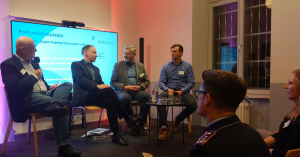
The Citizens’ Dialogue is part of the workshop series entitled Social Cohesion and Integration – #Together for a Strong Germany, in which the Federal Minister of the Interior aims to address current socio-political issues openly and constructively. The welcome address by Federal Minister of the Interior de Maizière was followed by a panel discussion. “Affection for churches has decreased, aversion to Islam or churches has increased,” said de Maizière at the start of the discussion, and asked where the distance and aversion to religion came from. Thomas de Maizère and Frieder Otto Wolf were joined on the podium by Gesa S. Ederberg, a rabbi in Berlin, Dagmar Mensink, a Catholic theologian, and Hamideh Mohagheghi, a researcher in Islamic and comparative theology at the University of Paderborn. In Leipzig, HVD President Wolf emphasized that people are not as dependent on religion as is often portrayed in the (political) public sphere. From the point of view of modern humanists, people can lead and shape their lives in a meaningful way without any religious beliefs and with an ethically sound view of life. What is important for this is “trust in ourselves and the community”, and individual freedom can only be lived meaningfully in a socially responsible way, according to Wolf. Religion is not “harmful per se”, said Frieder Otto Wolf. A much greater distinction needs to be made between enlightened and unenlightened religions, as well as between people who live an enlightened religious life and those whose religiosity and religious practice are insufficiently informed and reflected. There are problems on the part of all faiths, but even atheists are not enlightened per se. In any case, all religious communities must respect human rights and religious belief should not be “expected” or even demanded of anyone. Frieder Otto Wolf went on to say that he no longer saw the great dominance of the churches in Germany today, as was the case in previous centuries. However, in some areas there is still an urgent need for greater separation between state and religious institutions in order to take into account the interests and rights of the rapidly growing number of non-denominational and non-religious people – but also to ensure that all citizens can live together on an equal footing regardless of their denomination. He described ideological neutrality and consistent equal treatment on the part of the state as an important part of contemporary religious policy, which, from a humanist perspective, can do justice to the growing ideological diversity, including more and more non-religious people in the Federal Republic. On the way there, however, many political and legal reforms still need to be accomplished, said the HVD President. “We will continue to work on this and also see it as our task to organize ourselves accordingly,” said Wolf.