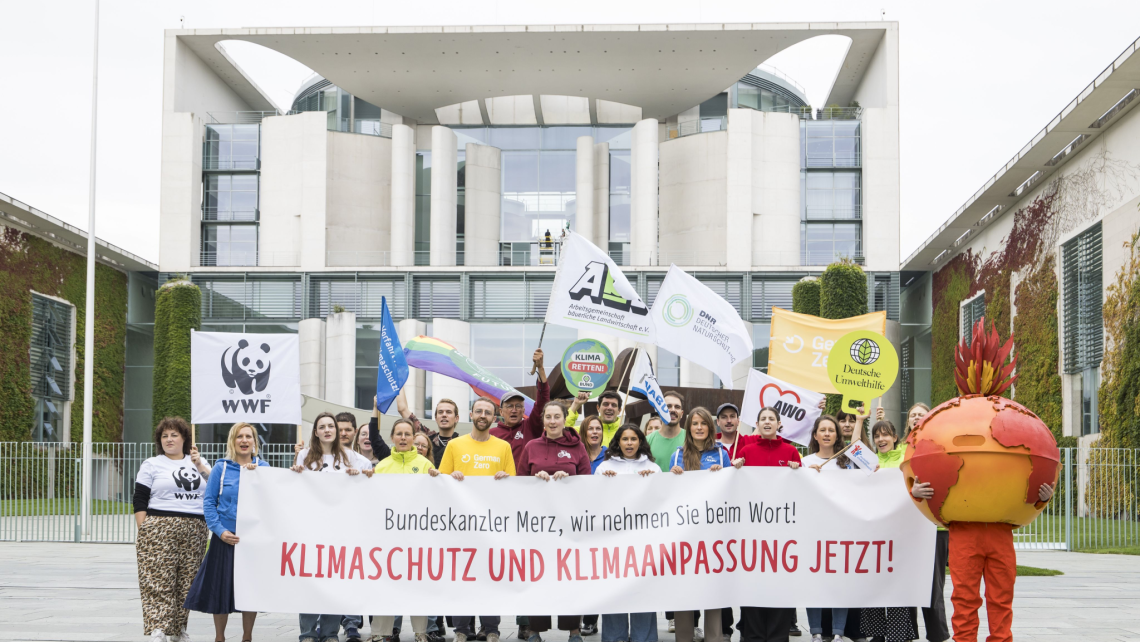
This record-breaking hot summer threatens to end without any political consequences. For despite thousands of deaths and the enormous strain on the population and the economy, the federal government still has yet to provide concrete answers. That is why we are once again making an urgent appeal to the federal government to adopt the necessary measures and allocate the necessary funding now to make Germany more climate-resilient and, in particular, to better protect vulnerable population groups.
We take the Chancellor at his word that his government intends to do everything it can to curb the climate crisis. We also take seriously the demands of the SPD ministers, who have advocated for a series of immediate measures and a constitutionally enshrined shared responsibility. Words and plans must now be followed by action.
Swift and consistent climate action is essential to keeping the consequences of global warming under control. More adaptation measures and greater investment in our natural resources are needed to protect us from increasingly frequent and severe weather extremes. This is the only way to address both the causes and the symptoms. A concerted national effort is now required.
We demand:
Pass the “Climate Protection, Adaptation, Nature” Prevention Package Now
The federal government must prioritize both climate protection and climate adaptation through an effective package of measures. This package must address extreme weather events such as heat, drought, and heavy rainfall and protect the population from their impacts. A policy initiative coordinated with the states is therefore needed to improve concrete protection against extreme weather. This includes a nationwide, binding heat protection plan with clear responsibilities assigned to the various levels of government—federal, state, and local.
It is also necessary to establish a national heat crisis coordination team and a nationwide warning system. The healthcare system must be specifically strengthened to prevent heat-related deaths.
To mitigate the effects of the climate crisis, we need climate-resilient, green, and cooler communities; the protection and accelerated restoration of ecosystems with high water retention and storage capacity; and climate-resilient practices in agriculture and forestry. The strategy development enshrined in the Climate Adaptation Act (KAnG) must be followed by concrete measures.
But if the climate crisis continues to escalate, we will no longer be able to adapt. It is primarily the burning of coal, oil, and gas that continues to drive global warming. We must therefore consistently accelerate the expansion of renewable energy, drastically reduce our dependence on fossil fuels, and advance electrification across all sectors. This includes climate-friendly heating and well-insulated buildings, increased electric mobility, and a push for public transportation. Existing climate protection goals, laws, and programs must not be called into question and must be backed by adequate funding.
The federal government must review all relevant legislative proposals to determine how they contribute to achieving climate goals and live up to the commitment made by Chancellor Merz to do everything possible to curb climate change.
Invest Now Instead of Cutting Back
The consequences of the climate crisis are costing the German economy many times more than investments in climate protection and climate adaptation—already at least 36 billion euros this summer. Many of the necessary measures actually contribute to both climate protection and adaptation—whether through the protection of wetlands and floodplains or the modernization of buildings.
The federal government must provide the financial resources needed to fund these necessary investments. This requires more funding in future federal budgets—not the cuts currently planned. All revenue from emissions trading and the corresponding funds from the special trust fund must be channeled into climate protection investments, natural climate protection, and social equity. Funding for building retrofits and heating system replacements must not be cut; it must be increased.
The need for action is particularly urgent in social services such as long-term care facilities and daycare centers. They require reliable investment support in the form of a dedicated funding program for energy-efficient renovations and heat protection. Funding programs for climate protection and adaptation in municipalities must be expanded and continued, and made more accessible and reliable through simplification and the use of flat-rate payments. Funds that directly undermine the preservation of natural resources—particularly fossil fuel subsidies—must be phased out and restructured.
A New Joint Initiative for Greater Reliability and Clarity
Local governments play a key role in investments in climate protection, climate adaptation, and nature conservation. In all three areas, the crucial implementation work usually takes place at the local level. However, the billions in deficits of recent years severely limit local governments’ ability to act. While allocations from the states’ share of the Special Fund for Infrastructure and Climate Neutrality are welcome, they fall far short of the funding actually needed and are often diverted to other priorities.
To provide cities and municipalities with predictable and adequate funding on a long-term basis to fulfill their responsibilities in climate protection, climate adaptation, and nature conservation, a joint task under Article 91a of the Basic Law is the instrument of choice. It enables the federal government to participate alongside the states and provides planning and financial certainty for local governments.
We are already feeling the effects of the climate crisis: It is crucial that we prevent it from escalating further and adapt as best we can to the inevitable consequences